Nerves Are Physical, Not a Character Flaw
Your body treats standing in front of people as a threat. Adrenaline, faster heart rate, shaky hands, dry mouth. That response is automatic and it doesn’t care that the audience is friendly.
Two consequences worth knowing in advance. Your technique compresses under adrenaline, so anything you can only just play at home becomes unreliable. And your perception of time distorts. A song that takes three minutes will feel like forty seconds.
Neither is a sign that you’re not ready. They’re what happens to everyone, including people who have done it for fifteen years.
Preparation That Actually Helps
Over-prepare one song. One song you know cold beats three you half know, by a wide margin. Pick whatever you can play at 80% on a bad day, because that’s roughly what nerves will leave you with.
Practise it standing up. If you’ll be standing, rehearse standing. The guitar sits differently and your fretting hand angle changes more than you’d expect.
Rehearse the start and the ending. The two moments most likely to unravel. Know exactly how you begin and exactly how you finish.
Have a recovery plan. If you get lost, stop, breathe, and come back in at the top of the next section. Knowing this in advance removes most of the fear, because a mistake becomes a two-second event instead of a catastrophe.
Slow your breathing before you start. Long exhale, longer than the inhale. It genuinely lowers the physical response.
What performers actually learn over time
Not how to stop feeling nervous. How to play well while feeling nervous. Those are different skills, and only the second one is achievable.
The Room Matters More Than Your Playing
A first open mic at a bar full of strangers waiting for the next act is a very different experience from a room of people who all know exactly what you’re feeling.
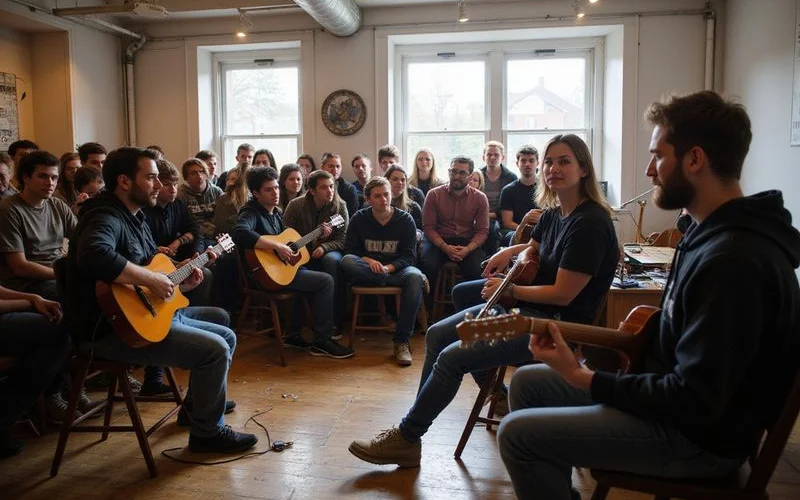
The Sessions is the second kind by design. Members-only, 20 to 30 current and recent students, all somewhere on the same path. Half the room is nervous too. The reaction to a first-timer is warmer than the reaction to anyone else in the night, every time.
Starting there means your first experience of performing is a good one, which shapes whether there’s a second one.
The Half Hour Before
A few practical things, in order.
Tune before you’re called. Tuning on stage with adrenaline is harder than it sounds, and it eats the first thirty seconds of your slot.
Warm up your hands. Cold hands under nerves make everything worse. Two minutes of anything is enough.
Avoid running the song repeatedly. More repetitions at that point don’t help and often build tension. Play something easy instead.
Breathe long and slow. Longer out than in. It genuinely lowers the physical response.
What to Do When It Goes Wrong
It will, at some point, and having a plan makes it a non-event.
If you forget a lyric, hum or repeat the previous line. Almost nobody in the room knows your song well enough to notice.
If you lose the chord progression, stop playing for a bar, listen to what you were doing, and come back at the top of the next section.
If your hands shake, simplify, play the chords and drop the picking pattern. Nobody is comparing your performance to your bedroom version.
If you truly grind to a halt, say so and start again. Audiences at a room like this respond warmly to that, every time.
Perspective From Someone Who Does It Weekly
Over 100 shows a year, and the nerves never fully go. They change shape, less fear of the room, more attention to the details of the set. What experience actually buys you is knowing that a mistake doesn’t matter, that the audience is on your side, and that the version in your head where everyone is judging you doesn’t exist.
You get that knowledge one way: by doing it once. What to expect walks through the format so nothing on the night is a surprise.