The Repertoire Lean
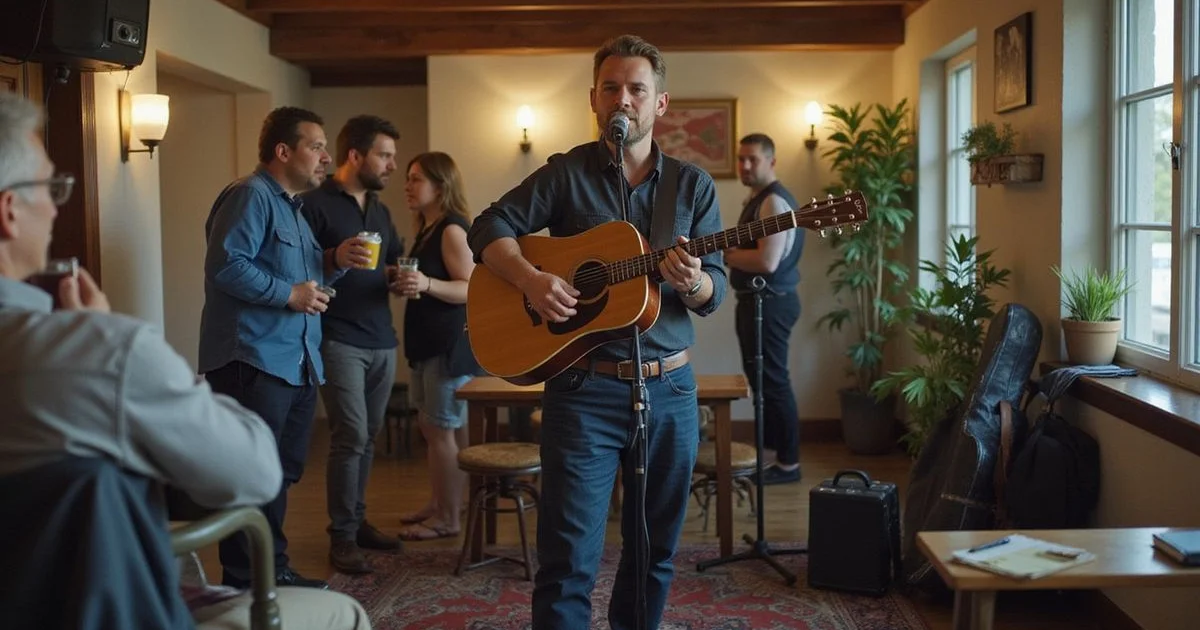
Classic rock, coffeehouse covers, and feel-good favorites. Songs people recognise from the first few bars, arranged for one guitar and one voice.
That leaning exists because it works across a wide range of guests. A room with a forty-year age spread still shares a surprising amount of common ground, and that overlap is where a solo set for live music at private events should live.
Matching the Moment
The same performer plays quite differently across an evening.
Ceremony. Quiet, often instrumental, no attention pulled from what’s happening. Processional and recessional chosen in advance and rehearsed properly.
Cocktail hour. Warm and conversational. Guests are talking and meeting each other; the music sits underneath and keeps the room from feeling empty.
Dinner. Similar, maybe slightly fuller. Familiar songs, nothing that demands attention mid-course.
Party. Livelier and more recognisable. This is where a set can lift the energy rather than support it.
The measure of a good event set
Guests can talk comfortably, and they notice the music when they stop talking. If either half fails, the volume or the repertoire is wrong.
How Requests Work
Send them early. A handful of specific songs is completely normal, and for a wedding they’re often the most memorable part of the day.
The songs worth the most advance notice:
- First dance, needs a proper solo arrangement
- Processional and recessional. Timing has to fit the walk
- A song that means something to you, worth getting right rather than approximating
Some songs don’t translate to solo guitar. Anything whose identity lives in a full band arrangement can feel thin with one instrument. You’ll get an honest answer on that rather than a disappointing surprise, usually along with an alternative that captures the same feeling. Timing for when to send the list is covered in booking a solo guitarist.
What Works Solo, and What Doesn’t
One guitar and one voice can cover a lot, but not everything, and it’s better to know which is which before the day.
Works well: singer-songwriter material, classic rock built on strong chord progressions, folk and country, soul and Motown adapted to a groove, and most acoustic-era pop. Anything whose identity lives in the melody and the chords translates cleanly.
Harder: songs defined by a specific production, a synth hook, a horn line, a drum pattern that carries the whole thing. These can be arranged, but they become a different version rather than the one guests are picturing.
If a song matters to you, ask. You’ll get a straight answer and usually a suggestion that lands the same feeling.
Reading the Room on the Night
A set list is a plan, not a script. If the room is quieter than expected, the tempo comes down and the material softens. If it lifts, the set follows.
That responsiveness is most of what an experienced performer brings, and it’s why a fixed running order agreed weeks earlier is usually less effective than a rough shape with room to move. The exception is the fixed moments, a processional, a first dance, an announcement cue, which are rehearsed to the second.
Building the Set Around Your Crowd
The most useful thing you can tell a musician is who’s in the room. A wedding with a lot of guests over sixty, a company party for a young team, and a backyard birthday for close friends all want different sets, and that information is worth more than a long request list.
Anything you’d rather not hear is equally useful. A short do-not-play list saves everyone an awkward moment.
For the booking mechanics, see live music for private events. For recurring bookings in a dining room or lobby rather than a one-off event, restaurants and hotels covers the hospitality side.