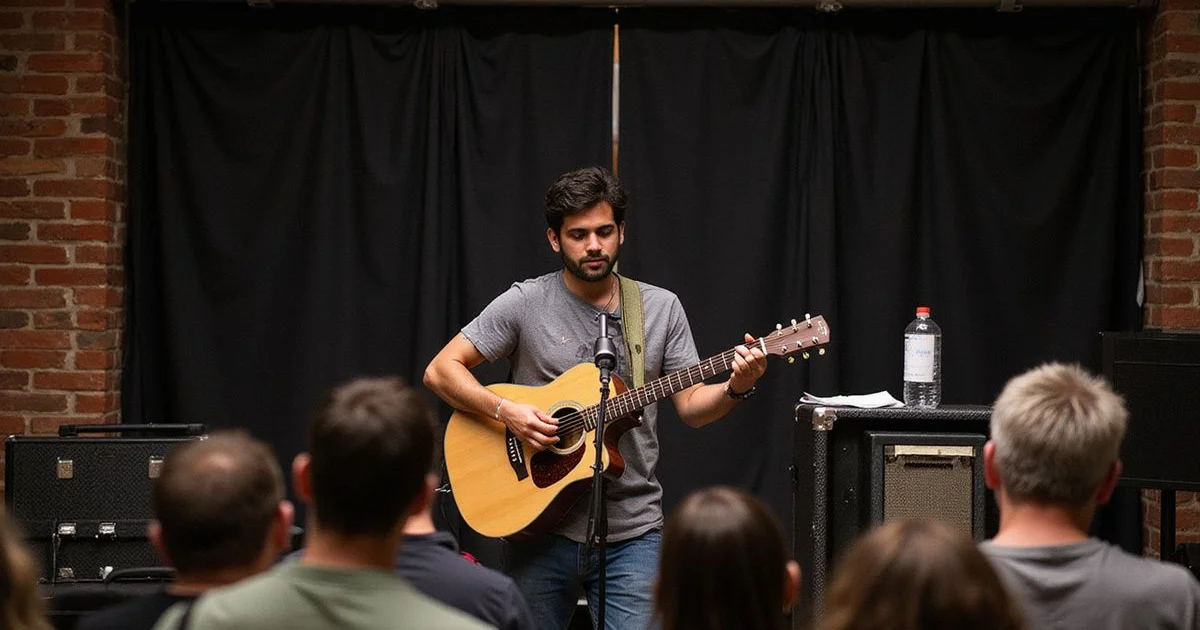
Teaching the Way He Wishes He’d Been Taught
Sameer Saleem plays guitar for a living in Austin. Over 100 shows a year at venues, hotels, restaurants, and private events, with regular rooms including Cedar Door, Geraldine’s, Hotel Indigo Austin, and The Rainey House.
He teaches because of how he learned. Years of practising hard on things that didn’t move the needle, with nobody to tell him which of those hours mattered. The curriculum he built for students is designed to cut that wasted time out, and it starts from a fairly unglamorous premise: most stuck guitarists aren’t short on effort, they’re short on sequence.
That’s the argument behind adult guitar lessons in particular, where nearly every student arrives carrying some version of the same story.
Why the Gigging Matters
Plenty of guitar teachers stopped performing a decade ago. That’s not a character flaw, but it changes what they can tell you.
An active performance schedule means the advice comes from a stage rather than a book. What actually happens when a room goes quiet mid-song. How a part is really played live versus how the tab writes it. What to do when you can’t hear yourself in the monitor. Which of your gear frustrations are real and which are settings.
It also means the theory has a job. Understanding harmony isn’t an academic exercise when you have to transpose a song on the fly for a singer at a private event on Saturday.
The teaching philosophy in one line
Theory gets applied in the same lesson it’s taught, on the song already in front of you, because a concept you can’t use that day rarely survives the week.
What He Teaches, and What He Doesn’t
Acoustic guitar, electric guitar, vocals, and music theory. That’s the whole list.
No bass, no piano, no drums. Requests outside those four get a referral to someone who actually specialises, not a booking. It’s a small thing that says most of what needs saying about how the studio operates, teaching an instrument you only half play does nobody any favours, least of all the student paying for it.
The Community Half
The other half of the offer is people. Learning guitar as an adult is a solitary hobby by default, and isolation is what kills momentum long before difficulty does.
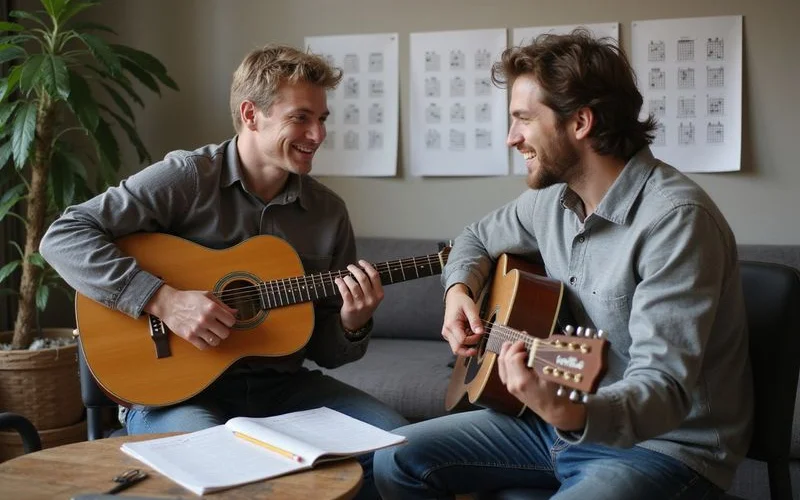
So every subscription includes The Sessions, the monthly members-only open mic, along with Songwriting Circles and Jam Sessions. No extra charge, no minimum months. Students consistently name the community as the thing that changed the most, and not because it’s fun, though it is, but because playing with other people exposes gaps a bedroom never will.
The Sequence, Not a Method Book
The curriculum runs on a sequence rather than a fixed book: ear training, applied theory, rhythm, repertoire, and performance, layered in an order that builds. What changes student to student is the material it’s built from.
A method book assumes everyone wants the same thing and arrives with the same gaps. Neither is true. A 45-year-old restarting after twenty years off, a teenager chasing a specific riff, and a parent booking for a nine-year-old need genuinely different first months, even though the underlying skills are the same.
So the sequence bends around what you actually want to play. That’s not a marketing line, it’s the practical reason students still practise in month six, which is where most people quietly stop.
The Instruments, and the Referrals
Acoustic guitar, electric guitar, vocals, and music theory. Requests outside those four get a referral to a specialist rather than a booking, which occasionally costs a subscription and consistently keeps the teaching honest.
The same principle applies to fit. Some students want a rigid classical program. Some want to be pushed harder than this approach pushes, and some kids simply aren’t ready yet. In each case saying so at the consult is better for everyone than discovering it in month three.
The Honest-Fit Promise
Every relationship starts with a free 15-minute consult over Google Meet, evenings and weekends included. Nothing gets sold on that call.
The point of it is fit. Sometimes that means mapping out a first three months. Sometimes it means suggesting a different teacher, or telling a parent their seven-year-old would do better starting next year. A 5.0 rating across 70+ Google reviews is easier to maintain when you decline the students you can’t serve well.
When you’re ready to have that conversation, book a free consult.