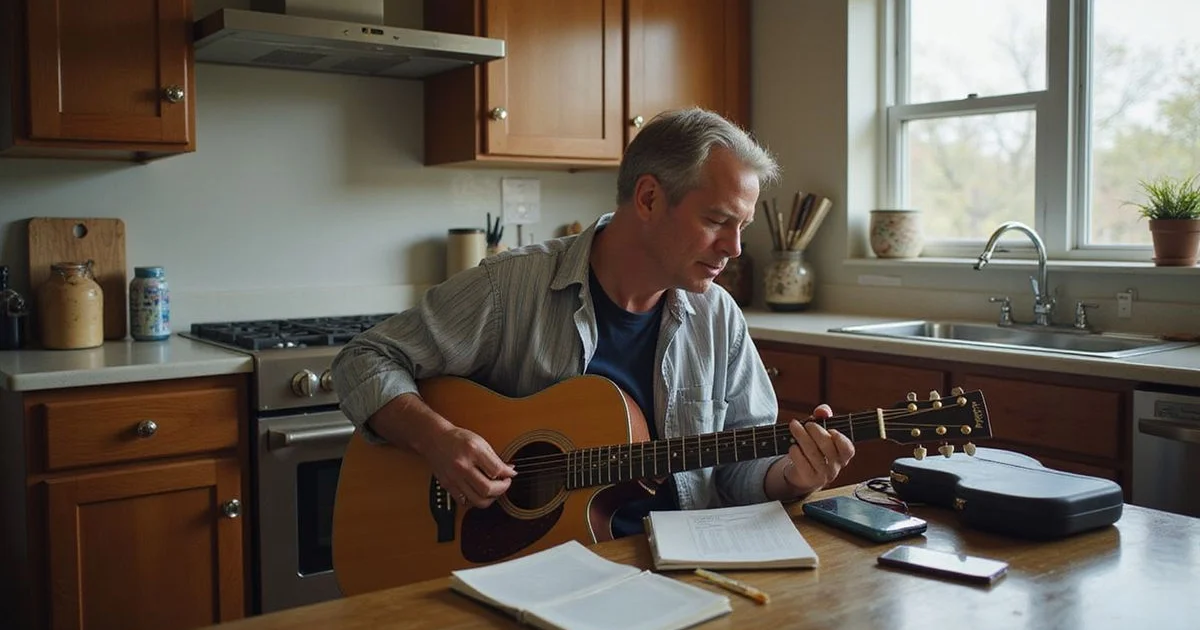
The Short Answer Is No
You’re not too old. Students start here in their 40s, 50s, and 60s regularly, and roughly a third of all students begin from zero regardless of age.
The worry behind the question is usually not really about age. It’s about whether the years already spent not playing have closed something off permanently. They haven’t. What those years cost is time, not capacity, and the difference matters because one of those is recoverable.
That’s the premise the whole adult guitar lessons approach is built on.
What Actually Changes With Age
Two things, honestly.
Physical habit forms a little slower. A twelve-year-old builds finger independence and muscle memory faster than a fifty-year-old. This is real, and it’s smaller than people assume, measured in weeks across a first year, not in whether the skill is achievable.
Practice time is scarcer and more fragmented. This is the bigger constraint by far, and it’s about your calendar rather than your age.
What Doesn’t Change, and What Improves
Adults have three advantages that children don’t, and they compound.
You know what you want to sound like. A kid usually plays what they’re handed. You have thirty years of listening behind you and a specific list of songs. That taste is a compass, and having one shortens the path enormously.
You can understand structure. Applied theory that a twelve-year-old has to absorb by repetition, an adult can grasp in one explanation and start using the same day. Understanding why a progression works lets you skip a great deal of trial and error.
You practise deliberately when you practise at all. Children repeat. Adults can diagnose. Twenty focused minutes of an adult noticing which finger lands late beats an hour of unfocused repetition at any age.
The real predictor of progress
Not age. It’s whether the practice is aimed at the right thing. Adults who plateau for years almost always plateau on practice order, not on capability.
What the First Month Looks Like
Most adults play a recognisable song, in simplified but complete form, within the first month. Not a performance. A song, start to finish, that a family member can name.
That milestone matters more than it sounds. It’s the thing that carries people through weeks three and four, when fingertips hurt and chord changes still stall. Technique built inside songs you like survives that stretch; technique built from exercises usually doesn’t. The rest of the timeline is mapped out in the first 90 days of adult lessons.
If You Played Before and Stopped
Very common, and it’s a different situation from starting cold. Old muscle memory comes back within a few weeks, often faster than you’d credit.
The trap is assuming you need to restart from the beginning. Usually you don’t. What you need is someone to identify the specific thing that stalled you the first time, nearly always fretboard visualization, rhythm, or theory that never connected to what your hands were doing, and rebuild from there.
What Adults Get Wrong About Their Own Progress
Two distortions come up repeatedly, and both make people quit earlier than they should.
The first is comparing yourself to players online. Video platforms show the top fraction of a percent, filmed after many takes. That’s a useless benchmark for anyone, and it’s the main reason adults conclude they’re not progressing when they are.
The second is expecting linear improvement. Guitar progresses in steps, a plateau where nothing seems to move, then a week where something clicks and everything before it feels easy. Adults who quit almost always quit inside a plateau, days or weeks before the step.
The Honest Ceiling
If the question underneath “am I too old” is whether you’ll become a touring professional starting at 55. The answer is probably no, and that’s true of almost everyone at any starting age.
If the question is whether you can play songs you love well enough to enjoy them, play with other people, and perform if you want to, then yes, comfortably. That’s the outcome the great majority of students are actually after, and age has very little bearing on reaching it.
Pace Beats Age
The one thing worth being honest about: if you expect to move at the pace of a teenager with four free hours a day, you’ll be disappointed. If you accept your own pace and aim your practice properly, the ceiling is much higher than the question assumes.
Fifteen minutes a day is a real practice habit and it produces real progress. Nobody has ever been held back on guitar by being 52.
The free 15-minute consult is the place to get a straight read on your specific situation, what you’ve played, what you want, and how long it should realistically take. Nothing gets sold on the call. Book a free consult.