
What Each Section Does
Structure is about managing attention. Each section has a job.
Verse. Moves the story forward. Lyrics change each time, the melody stays the same. Usually lower and more conversational than the chorus, which leaves room to lift.
Chorus. The hook, and the thing people remember. Same words every time. Usually higher, louder, and fuller than the verse.
Pre-chorus. Optional. A short section that builds tension into the chorus, often two to four lines that don’t recur anywhere else.
Bridge. One section that goes somewhere else, near the end. New chords, new melody, different perspective. Its job is contrast, so the final chorus feels earned.
Intro and outro. Bookends. Often just the chord progression from another section.
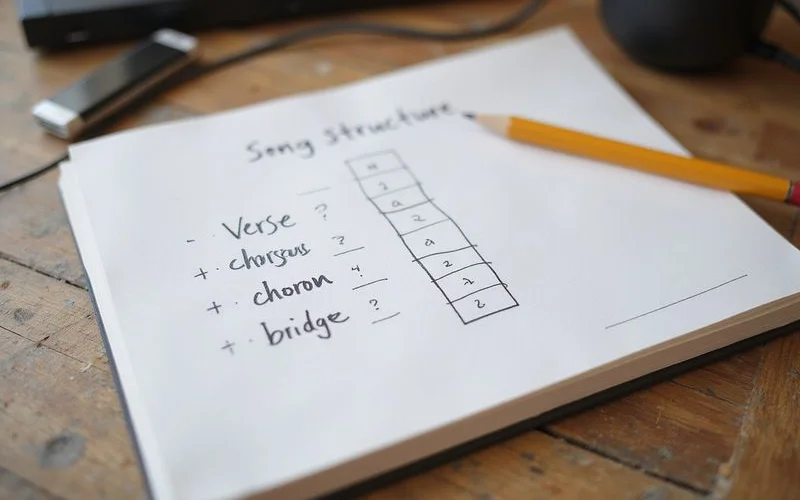
The Structures That Carry Most Songs
| Structure | Shape | Suits |
|---|---|---|
| Verse–chorus | V-C-V-C-B-C | Most popular music |
| Verse–chorus with pre | V-P-C-V-P-C-B-C | Songs that need a bigger lift |
| AABA | A-A-B-A | Standards, older pop, folk |
| Verse only | V-V-V-V | Story songs and traditional ballads |
Your first song does not need a bridge. Verse–chorus–verse–chorus is complete, and finishing something simple teaches more than abandoning something ambitious.
What Makes a Chorus Feel Like a Chorus
Contrast, more than melody. Something has to change when it arrives:
- Go higher in your vocal range
- Get louder, or add the strum you were holding back
- Change the rhythm, longer notes are a classic lift
- Simplify, sometimes dropping to one chord makes a chorus enormous
A chorus that sits in the same register with the same energy as the verse won’t land no matter how good the tune is. This is the most common fixable problem writers bring to the circle.
The bridge test
If you removed the bridge, would anyone notice? If not. It isn’t doing its job. A bridge has to genuinely go somewhere else.
Where Sections Usually Go Wrong
The second verse repeats the first. Extremely common, and the most frequent thing that stalls a half-finished song. The second verse has to move, new detail, a change in perspective, or a consequence of the first.
The chorus arrives too late. If the first chorus is ninety seconds in, most listeners have already decided. Getting there faster is nearly always an improvement.
Nothing changes between sections. Same register, same energy, same strumming. Structurally there’s a chorus; to a listener there isn’t.
The bridge is another verse. If it doesn’t go somewhere genuinely different, it’s padding.
Length and Pacing
Most popular songs land between three and four minutes, and the reason is attention rather than convention. Sections tend to run four or eight bars, which fits how listeners count without thinking about it.
That’s a starting point rather than a rule. Plenty of good songs use a six-bar verse or an unusually long instrumental section, and doing it deliberately reads as a choice. Doing it accidentally usually reads as a mistake, which is the whole argument for knowing the convention before departing from it.
Use Structure, Don’t Obey It
Knowing the conventions is what lets you break them on purpose. Starting on the chorus, dropping the second verse, ending on a bridge. All of these work, and they work because they play against an expectation the listener already has.
Formulaic songs aren’t the fault of the structure. They’re what happens when structure is the only decision being made.
Structure is one of the most common things worked on in the Songwriting Circles, because a room hearing your song once can tell you exactly where their attention wandered. What to bring and how the sessions run is covered in bring a song idea.