
What CAGED Actually Is
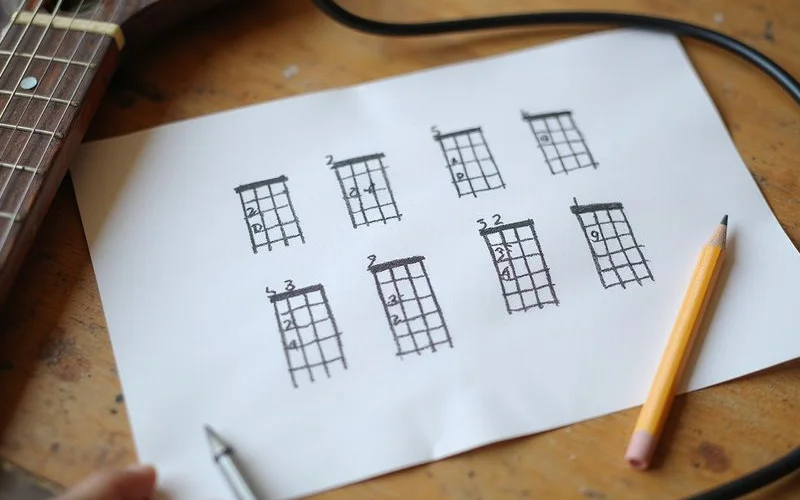
Five movable chord shapes, named after the open chords they come from: C, A, G, E, and D. It’s one of the first things covered in music theory lessons once fretboard note names are solid.
Every one of those open shapes can slide up the neck as a barre or partial barre. Do that with all five, and you have five different ways to play the same chord in five different positions. Together they cover the entire fretboard, and. This is the part that matters, they always appear in the same order, C-A-G-E-D, moving up the neck.
That’s the whole system. Not a scale, not a theory. A map.
Why It’s Worth the Effort
Most guitarists know a few chord shapes and one scale position, floating unconnected in the middle of the neck. Above the seventh fret, it’s guesswork.
CAGED replaces the guesswork with structure. Three payoffs:
You can find any chord anywhere. Useful for arrangements, and for staying in one area of the neck instead of jumping around mid-song.
You always know where the chord tones are. This is the big one for soloing. Landing on notes that belong to the current chord is what makes a phrase sound intentional, and CAGED shows you exactly where they live.
Scales connect to chords. Each pentatonic position sits around a CAGED shape. Once you see that, scale positions stop being five arbitrary boxes and become five views of the same harmony.
What CAGED is not
It’s not five shapes to memorise and recite. Learned that way it’s another set of disconnected patterns. Its whole value is in the connections between shapes.
The Order to Learn It In
1. One shape, all over. Take the E shape. Play it as a barre chord at several positions. Notice that the shape doesn’t change, only where it sits.
2. Add the A shape. Now find the same chord in two places. Play a song moving between them.
3. Find the root notes. In each shape, know which fingers are on the root. Everything else hangs off this, and it’s the step people skip.
4. Link two shapes. Play a chord in the E shape, then slide to the same chord in the A shape. That transition is where the map becomes real.
5. Add the remaining shapes. C, G, and D, one at a time. G is the awkward one for everybody.
6. Overlay the scale. Play the pentatonic position around each shape and notice how it wraps the chord tones.
Each stage should be applied to actual songs. CAGED practised in isolation is exactly the failure mode described in why scales aren’t helping.
Realistic Timeline
| Stage | What it feels like | Rough time |
|---|---|---|
| Understanding it | “Oh, that’s it?” | One lesson |
| Two shapes fluent | Finding chords in two places without hunting | 2–4 weeks |
| All five | Slow but navigable | 2–3 months |
| Automatic | You stop thinking about shapes entirely | 6+ months |
That last row is the point. When it’s working. You don’t think about CAGED at all. You just know where things are.
Common Mistakes With CAGED
Memorising shapes without roots. The single most common error. A shape you can play but can’t locate is a pattern, not a map. Know which fingers are on the root in every shape.
Learning all five at once. They blur. One shape applied to real songs for a fortnight beats five learned in an afternoon and forgotten by the weekend.
Treating it as a soloing system only. It’s equally useful for finding chord voicings, which is what makes arrangements sound fuller.
Expecting instant results. The understanding is quick, the fluency isn’t. That gap is normal and it’s where most people abandon it.
How to Tell It’s Working
Three signs, in the order they usually appear.
You stop hunting for a chord above the fifth fret. You know roughly where it is before you look. Then you start choosing voicings rather than accepting the first shape that comes to hand. Finally, when soloing. You know which notes belong to the chord currently playing without having to work it out.
That last one is the point of the whole system, and when it arrives it changes how the fretboard looks permanently.
Where It Pays Off
For lead players, it’s the direct solution to the plateau described on the electric lessons page. For anyone writing or arranging. It turns “I only know one voicing” into a genuine choice.
It’s a core part of music theory lessons for exactly the reason the whole approach exists: taught in the abstract it’s forgettable, and applied to the song in front of you it changes how you see the instrument.