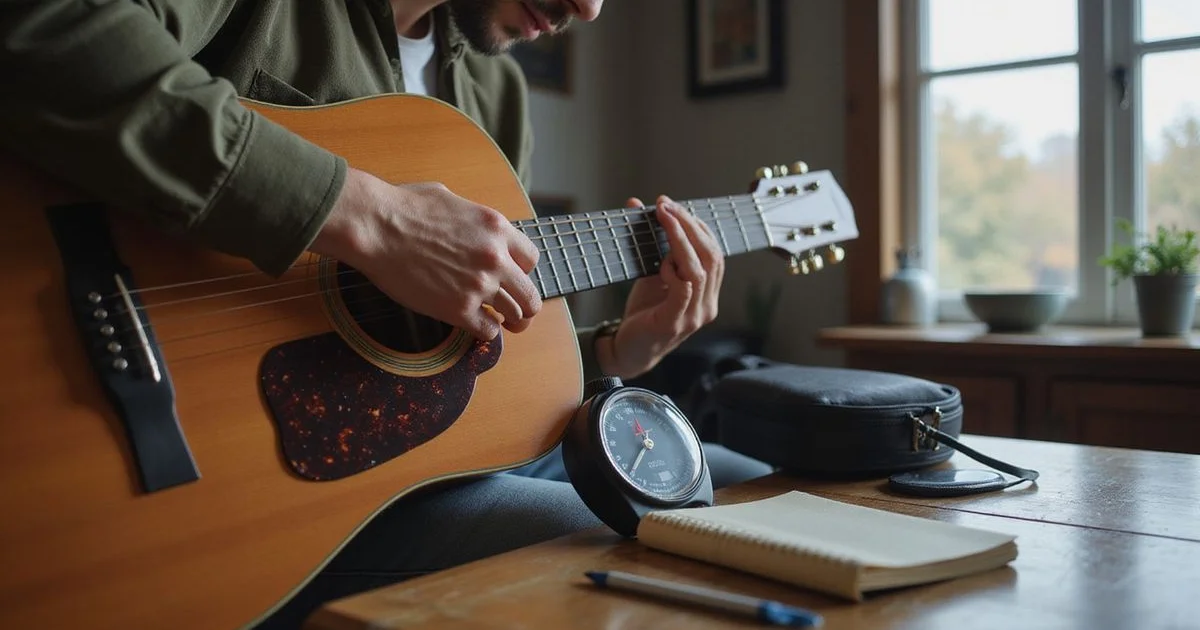
Timing Is the Most Ignored Weakness
Ask a guitarist what they’re working on and you’ll hear chords, scales, or a song. Almost nobody says timing, and almost everybody needs it, which is why rhythm sits alongside harmony in music theory lessons rather than underneath it.
That’s because timing errors are nearly impossible to hear in your own playing. Your sense of the beat drifts, and your playing drifts with it, so it sounds correct from the inside. You only find out when you play with other people, or when a recording of yourself is unlistenable in a way you can’t quite name.
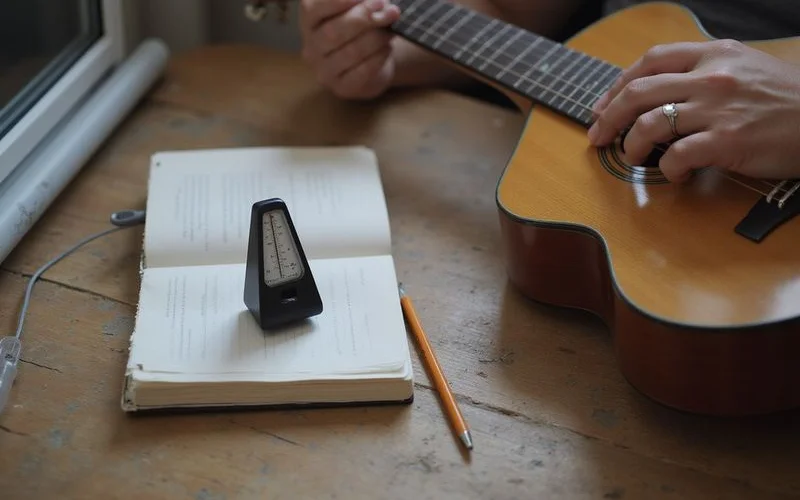
Why Timing Slips
You’re not feeling subdivisions. The most common cause. If you’re only tracking the main beats, everything between them is guesswork. Counting “one-and-two-and” out loud gives you the grid to place things on.
Your strumming hand stops. When a chord change is coming, the hand pauses to wait. That pause is the timing error. The hand has to keep moving whether the chord arrives on time or not.
Tempo isn’t consistent. Speeding up in easy sections and slowing down in hard ones is nearly universal and almost never noticed without a reference.
You’re playing too fast to be accurate. Same principle as slow chord changes, accuracy first, speed as a result.
The recording test
Record thirty seconds on your phone and play it back tomorrow. You’ll hear timing problems on playback that were invisible while playing. It’s uncomfortable and it’s the fastest diagnostic available.
The Practice That Fixes It
Count out loud while you play. Feels ridiculous, works better than anything else. “One-and-two-and-three-and-four-and.” You cannot count out loud and lose the grid at the same time.
Metronome on beats 2 and 4. Once basic metronome practice is comfortable, set it to click only on the backbeat. Suddenly you’re responsible for beats 1 and 3, and any drift is immediately audible. This is the single most effective timing exercise there is.
Keep strumming through everything. Down-up motion continues even when a chord is late or a string is muted. The pulse is the priority; the chord catches up.
Practise at a tempo you can hold. Slower than you’d like, clean for eight bars, then raise it slightly.
Play with other people. A jam exposes timing faster than any metronome, because two people can’t both drift the same way. The all-levels jams included with every subscription are the practical version of this.
Recording Yourself Is the Fastest Diagnostic
Nothing exposes timing like playback. Record thirty seconds on your phone, leave it a day, and listen without the guitar in your hands.
Two things usually surface. Tempo drift, speeding up in the easy parts, slowing in the hard ones. And the small stalls at chord changes that felt invisible while playing because your internal clock paused along with your hands.
It’s an uncomfortable exercise the first few times and it’s the single most efficient one available. You can’t fix what you can’t hear, and you genuinely cannot hear this from inside the performance.
Where Timing Shows Up Later
Timing is the skill that decides whether you can play with other people. Technique gaps get worked around in a group; timing gaps don’t, because everyone else is depending on the pulse.
It also quietly determines whether your playing sounds good to a listener. Given the choice between a player with three chords and solid time and a player with forty chords and shaky time, an audience will prefer the first every time, usually without being able to say why. It’s the same reason drilled scales stop paying off once rhythm is the thing holding you back.
Why It’s Worth Prioritising
Timing improvements make everything else you already know sound better immediately. A player with three chords and a solid pocket sounds good; a player with forty chords and shaky time doesn’t.
Rhythm is treated as core theory in music theory lessons for exactly that reason, subdivision, time signatures, and counting sit alongside harmony rather than beneath it. And it responds fast: a few weeks of short, focused work usually produces a difference you can hear on a recording.