Attention Span Sets the Format
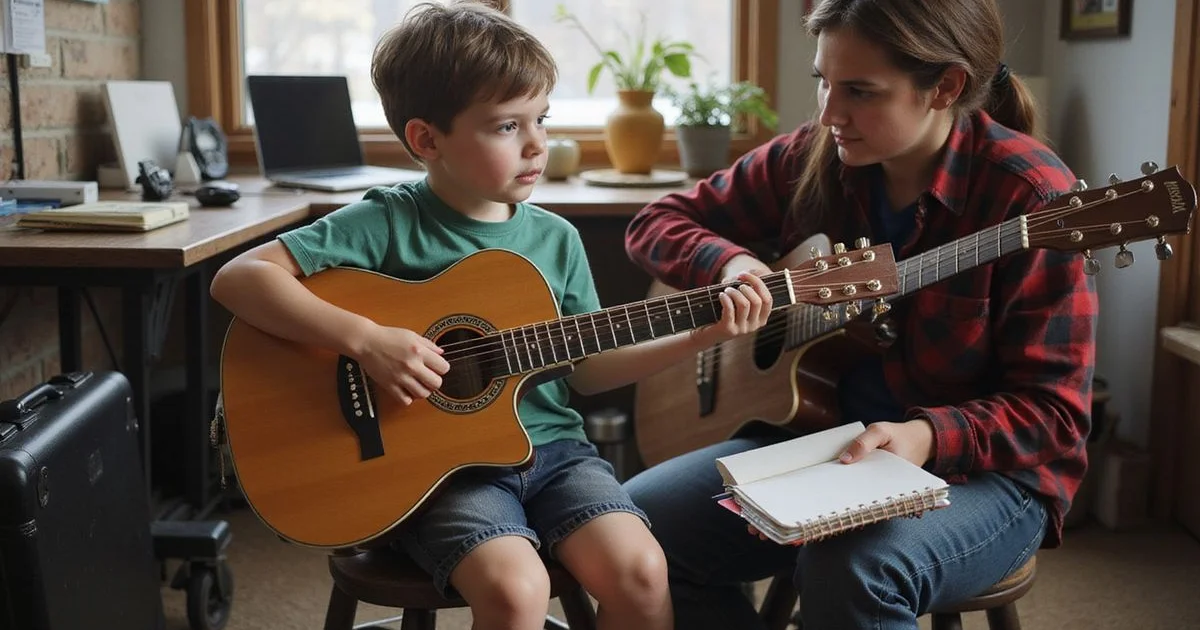
For children under about ten, the limiting factor in kids guitar lessons isn’t how much material exists. It’s how long they can stay engaged with it.
Past that point, more minutes stop adding value and start subtracting it. The last stretch of a too-long lesson tends to undo some of what the first part built, and more importantly. It changes how the child feels about the whole thing. That feeling is most of what decides whether your child sticks with lessons past the first few months.
Thirty minutes, ending while attention is still there, is usually the better format.
Side by Side
| 30 minutes weekly | 50 minutes weekly | |
|---|---|---|
| Best for | Roughly ages 6–10 | Roughly 11+, or highly focused younger kids |
| Monthly cost | $359 | $469 |
| Session shape | One or two clear targets | Warm-up, technique, song, theory |
| Risk | Feeling rushed as they progress | Losing focus in the last stretch |
Both tiers include the same things: free access to The Sessions, Songwriting Circles, and Jam Sessions, plus a written recap after every lesson. Full details are on the pricing page.
The counterintuitive part
A 30-minute lesson your child is engaged in for all 30 minutes beats a 50-minute lesson they check out of at minute 35, and it costs you less.
When to Move Up
Three signals, and you’ll usually notice them before anyone mentions it:
They’re practising unprompted. The reliable marker that the format has room to grow.
Thirty minutes starts feeling rushed. As material gets deeper, full songs, more parts, theory that needs unpacking, the shorter slot begins to bite.
They ask about things beyond the lesson. Curiosity that outruns the session length is a good problem.
For most children this happens somewhere around ten to twelve, but it tracks development rather than birthdays.
What 30 Minutes Actually Covers
A common worry is that a shorter lesson means less gets taught. In practice, a 30-minute session with a young child holds a surprising amount: a quick check of what was practised at home, one technical thing worked on properly, a chunk of a song, and a rhythm game that hides the boring part inside something they enjoy.
What it doesn’t hold is a long theory tangent or three separate pieces on the go at once. For a seven-year-old, that’s a feature. Depth in one place beats coverage across four, and it keeps the session ending on something they can play rather than something they’re still struggling with.
The written recap does more work in the shorter format too. Because there’s less time in the room, the practice plan for the week matters more, and it means you know exactly what to encourage at home instead of asking “did you practise?” and getting a shrug.
What a Longer Lesson Buys Later
By eleven or twelve, most students can hold focus for a full 50 minutes, and the extra time starts paying for itself. There’s room to work on a song and unpack the theory behind it in the same sitting, to fix a technical problem without cutting the fun part, and to leave five minutes for whatever they’re curious about that week.
That last part matters more than it sounds. The questions kids ask when there’s time for them, how does a capo work, why does this chord sound sad, are often where genuine interest turns into ownership.
What Doesn’t Change
The teaching approach is identical at either length: real songs first, technique built underneath them, rhythm work that plays like a game, and a written recap so you know what to encourage at home.
The format question gets covered at the free 15-minute consult, and the recommendation there is based on your specific child rather than a default. The rest of the parent-facing picture is on the kids guitar lessons page.