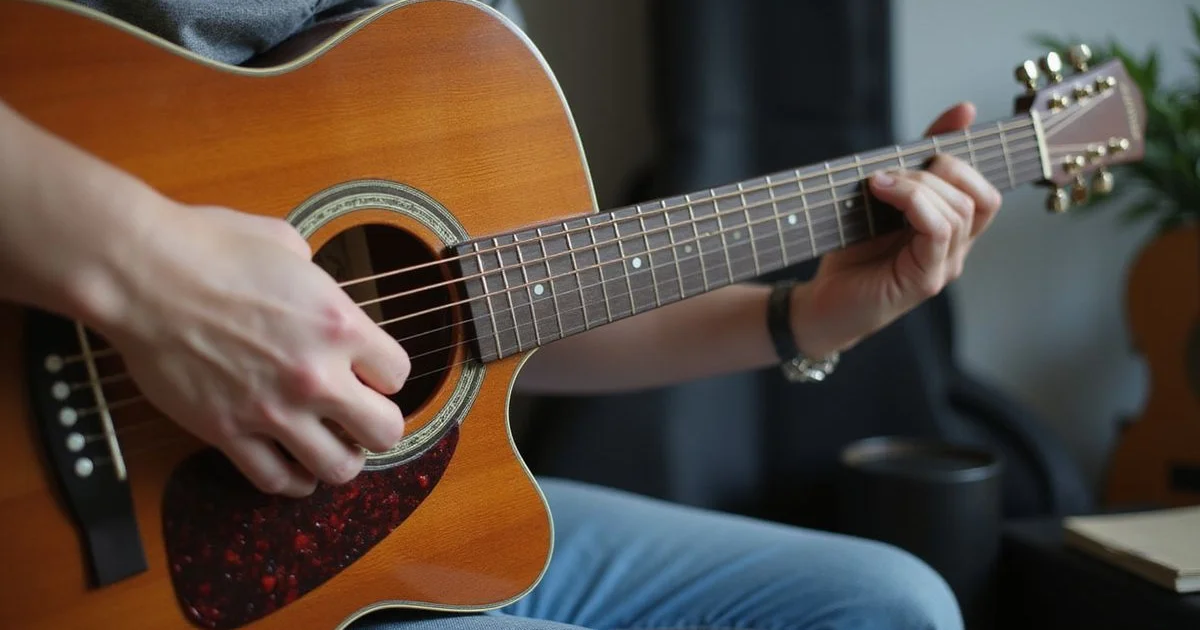
The Universal Beginner Wall
Every guitarist hits this. You know two chords. You can form each one cleanly. Moving between them in time takes about four seconds, and the song does not wait four seconds.
This is the steepest part of the learning curve and it’s also the shortest. Knowing that matters, because more beginners quit here than anywhere else, and almost all of them are two or three weeks from it resolving. Getting students past this wall quickly is most of what the first month of beginner guitar lessons is built around.
Why Transitions Lag
You’re rebuilding from scratch. Most beginners lift all four fingers off the neck and construct the next shape from nothing. Many chord pairs share a finger or a fret, and using that anchor cuts the movement in half.
Fingers move one at a time. Watching a beginner change chords. You can usually see the fingers land in sequence. They need to arrive together, which is a coordination skill built at slow tempo.
You’re practising too fast. Repeating a change at a speed where it’s never clean rehearses the error. Speed is a by-product of accuracy, in that order and not the other one.
You’re pressing too hard. Excess pressure has to be released before the hand can move. Lighter fretting is quicker to leave as well as less tiring.
The diagnostic question
Which finger arrives last? If you can answer that. You know what to practise. If you can’t, you’re going too fast to observe your own hands.
The Drill That Works
Take the two chords that are sticking. Just those two.
- Form the first. Look at your hand. Note which finger is doing the most work.
- Change to the second as slowly as needed to land all fingers together.
- Change back. Same speed.
- Repeat for two minutes without a metronome, watching your hand.
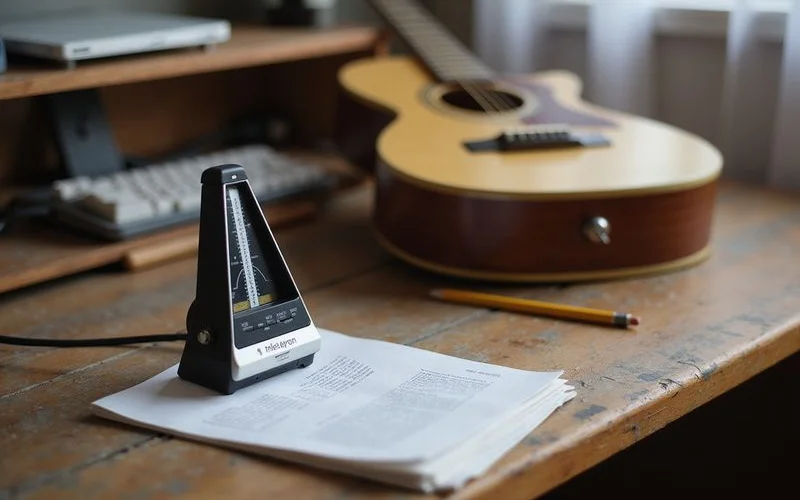
- Add a metronome at a tempo where it’s genuinely clean, usually slower than feels dignified.
- Raise the tempo one small step only after two clean repetitions in a row.
Two minutes a day on one specific pair does more than twenty minutes of playing the song from the top. The song rehearses the parts that already work; the drill fixes the part that doesn’t. That distinction is the whole of what practising right means.
Two Fixes That Feel Like Cheating
Keep the strumming hand moving. Don’t stop strumming to wait for the chord. Strum through the change even if the chord arrives a fraction late. The song stays continuous, and your hand catches up faster than it does with a stop-start habit.
Simplify the shape temporarily. A partial version of a chord that sounds fine in context is a legitimate stepping stone, and plenty of working players use those shapes permanently.
The Chord Pairs Worth Drilling First
Not all transitions are equally common. A handful appear in an enormous number of songs, and getting those fluent unlocks more repertoire than working through every combination.
Focus on the pairs that show up in whatever you’re currently learning, plus any change that involves moving more than two fingers at once. Those are the ones where the “arrive together” problem bites hardest.
Once a pair is clean at a slow tempo, put it straight into a song. A change that works in isolation but collapses in context hasn’t transferred yet, and the context is the whole point.
How Long This Actually Takes
Two to four weeks of focused daily work on a specific pair, for most people. Slower if you’re only picking up the guitar twice a week, because this is a muscle-memory problem and muscle memory decays between sessions.
It’s worth being explicit about the shape of it: nothing seems to improve for a while, and then one day the change simply happens without you thinking about it. That’s how motor learning works, and knowing it’s coming is what gets people through the flat stretch in the middle.
When It Isn’t Just Practice
Sometimes the problem is mechanical rather than a lack of reps: a thumb wrapped over the neck blocking the stretch, a wrist angle that makes one shape unreachable, or a guitar with high action that requires too much force. These take a couple of minutes to spot in person and can be practised around, unsuccessfully, for a year.
That’s the case for having someone watch your hands, which is the core argument on the beginner guitar lessons page.
If the changes are clean but the song still sounds wrong. The problem is usually rhythm rather than chords, see timing and rhythm.