The Short Answer: About a Month
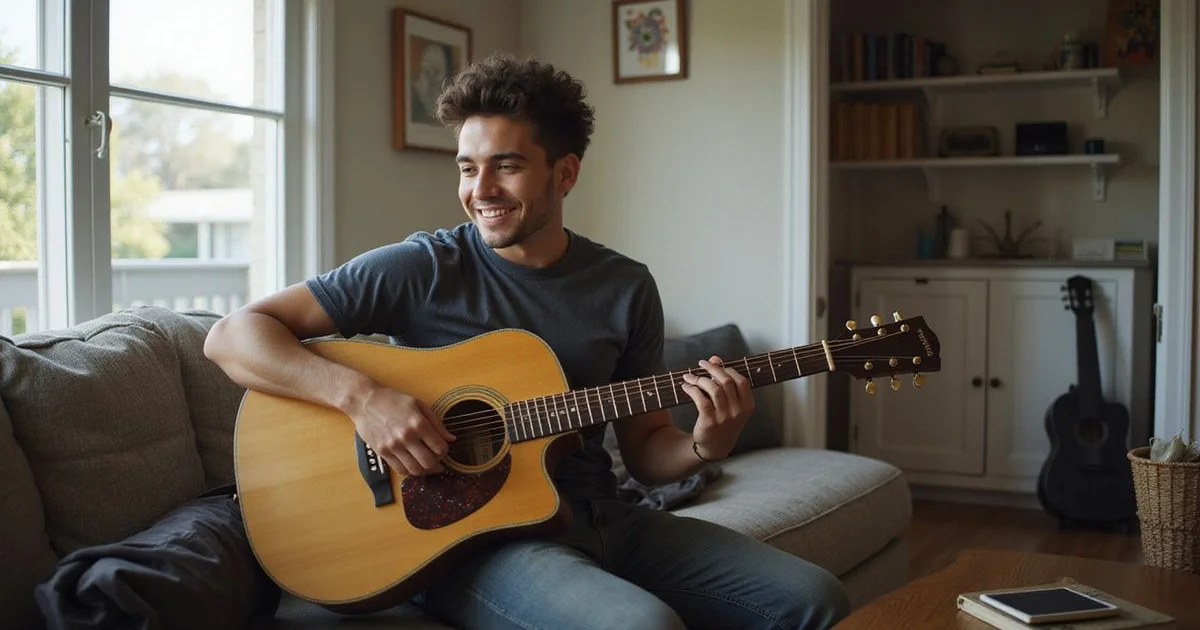
Most beginners playing fifteen to twenty focused minutes most days can play a simple song start to finish within the first month. Often sooner.
Two things need saying about that. The song will be simplified, a straightforward strumming pattern, possibly a capo to avoid a hard chord, maybe one section trimmed. And it will not be polished. But it will be complete and recognisable, which is a genuine milestone rather than a participation trophy.
Why It’s Faster Than People Expect
Because an enormous number of songs are built from the same handful of open chords. Once you have three or four of them and a steady strum, the limiting factor isn’t your chord vocabulary, it’s the speed of your transitions.
That’s the whole reason technique here gets built through songs instead of exercises, as laid out on the beginner guitar lessons page. The exercises hidden inside a song you like get practised; the same movements on a worksheet don’t.
What actually determines the timeline
Not talent, and not hours. It’s how many days a week you touch the instrument, and whether the song you picked was a reasonable target.
What Speeds It Up
Short and frequent. Five sessions of fifteen minutes beat one of ninety. Muscle memory consolidates between sessions, so frequency does the work.
Pick a song with few chords. Two to four chords, no barre chords, moderate tempo. Plenty of very good songs qualify.
Use a capo. A capo moves a whole song into a shape you can already play. It isn’t cheating, working musicians use them constantly.
Practise the changes, not the song. If one transition keeps breaking, take those two chords out and drill them slowly. Playing the song from the top over and over mostly rehearses the parts that already work.
Get the timing right early. More first attempts fail on rhythm than on chords, and rhythm is what makes a song identifiable.
Good First Songs
The best first song is one you already love that happens to use a few open chords and a steady strum. That description covers a huge amount of folk, country, rock, and singer-songwriter material from the last sixty years.
What to avoid for now: anything built on barre chords, fast tempos, fingerstyle arrangements, or intricate picking. Those arrive later and they arrive faster if you don’t fight them at week two.
Bring three songs you’d love to play to your first lesson. At least one will be workable sooner than you think, and the other two become targets.
Why “A Song” Is a Moving Target
Part of what makes this question hard to answer is that “playing a song” covers a wide range.
Playing the chords in time with a simplified strum is achievable in weeks. Playing it with the original strumming pattern, the right dynamics, and a clean intro takes months. Playing it and singing at the same time is a separate skill again.
None of that diminishes the first version. A simplified but complete song is a genuine milestone, and it’s the one that keeps people practising long enough to reach the others.
What to Do With Your First Song
Play it for someone. This sounds trivial and it isn’t. A song played alone stays private, and a song played for another person becomes a thing you did.
Then keep it. Most beginners abandon each song as soon as the next one starts, and end up six months in with nothing they can perform on request. Keeping three songs permanently in rotation while learning new ones costs about five minutes a week and gives you an actual repertoire rather than a list of things you once half-learned.
Then What?
By the end of the first two months most students have two or three songs they could play for someone without warning. That’s the real threshold, not the first song, but the point where you have a small repertoire and playing stops feeling like an exam.
The week-by-week version of how that unfolds is in first 8 weeks.